Saturday, January 31, 2009

Further thoughts on wind power

After Wednesday and Friday's class, I'm curious about whether wind farms could actually be viable habitats for marine organisms. The journal I first looked into, by Petersen and Malm, seems to indicate that, depending on the type and location of turbine structures, they could either create new habitat or provide a foothold for invasive species. The journal's point that "new structures may have a very low diversity and primarily host a few dominating opportunists" sounds alarming, but at the same time, the University of California at Santa Barbara has been researching marine organisms on offshore oil rigs both in terms of potential medical value and how viable the ecosystem is. I was curious, so I looked into it further.

Apparently, oil rigs can become quite fertile grounds for artificial reefs. The Washington Post featured an article on old oil rigs in the Gulf of Mexico, and how they are breeding grounds for tens of thousands of fish, as well as rare coral. The old oil rigs protrude up into the photic zone of the water, where photosynthetic organisms can thrive, and provide a solid substrate for them to attach to. They're even a target of interest for aquaculture.

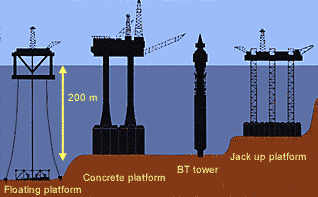
Naturally, just because oil rigs have had a positive impact, it doesn't necessarily mean that wind farms will as well. For one, the Gulf of Mexico is a very different environment from the Pennsylvania coast where Bluewater Wind intends to place their turbines. In addition, Petersen and Malm pointed out that the shape and texture of the substrate makes a huge difference in the type of organism that can thrive. An oil rig, like one of these:


(from solarnavigator.net)

is going to have a very different impact than a wind turbine:


(from offshorewind.net)

In addition, effects will not be immediate: Petersen and Malm point out that it takes up to five years for a stable community to establish itself. Still, plenty of data has already been accumulated on existing artificial reefs. Perhaps, using that data, marine biologists could make some predictions on whether the wind turbines will have an ultimately beneficial or harmful effect.

Wednesday, January 21, 2009

Wind Power and the National Energy Situation

(re: this New York Times article about Bluewater Wind)

It's great to see that Delaware is moving towards replacing old coal plants with wind power. From the standpoint of the environmentally concerned, it seems like getting anything done in the energy industry -- especially anything that could lead to an increase in energy and utility costs -- is an uphill battle. In the long run, converting to cleaner and renewable energy can only be beneficial.

But what caught my eye was a quote from Lester Brown of the Earth Policy Institute, stating that we need "the grid equivalent of the Eisenhower Interstate Highway System." We currently have a state-by-state patchwork of different energy policies. The article mentioned T. Boone Pickens as a major player with his nationwide wind program. This is a name that's familiar to me, so I had a look at his website.

PickensPlan

As an environmental studies student, I'm used to looking at potential new policies and developments from the perspective of how they'll help or harm the environment. Pickens seems to be looking from the perspective of how they'll help or harm our economy, and it's refreshing to see how closely our interests can align. He cites figures of how many billions of dollars we throw overseas at foreign oil. Domestic wind, he claims, should produce new jobs, keep the money we were formerly spending on oil at home, and provide a crucial step towards energy independence.

The New York Times article cites the cost of his project at $43 billion. This is hardly a small endeavor, and that money has to come from somewhere. In our current economy, it'll take some doing to convince people that it's worth it to take a chance on wind power. But with examples like Bluewater Wind as precedent, I remain hopeful.